15/10/2026


Southeast Asia represents an important growth opportunity for European brands. Through leading marketplaces such as Lazada, Shopee, or TikTok Shop, brands can reach consumers in countries such as Singapore, Malaysia, and the Philippines without establishing their own ecommerce websites. However entering these markets can be highly complex without a clear understanding of local dynamics.
Neticon helps European brands expand into Southeast Asia. Together with our Singapore-based company, Armonia Pte Ltd, we integrate brands’ systems with local marketplaces and support their ecommerce operations.
We are working to make this expansion progressively simpler, reducing technical complexity and developing broader operational support so brands can reach local consumers with less effort.
According to the DBS Nextwave Southeast Asia 2025 report, e-commerce sales across Southeast Asia are projected to more than double from USD 184 billion in 2024 to USD 410 billion by 2030, representing a 14% CAGR.
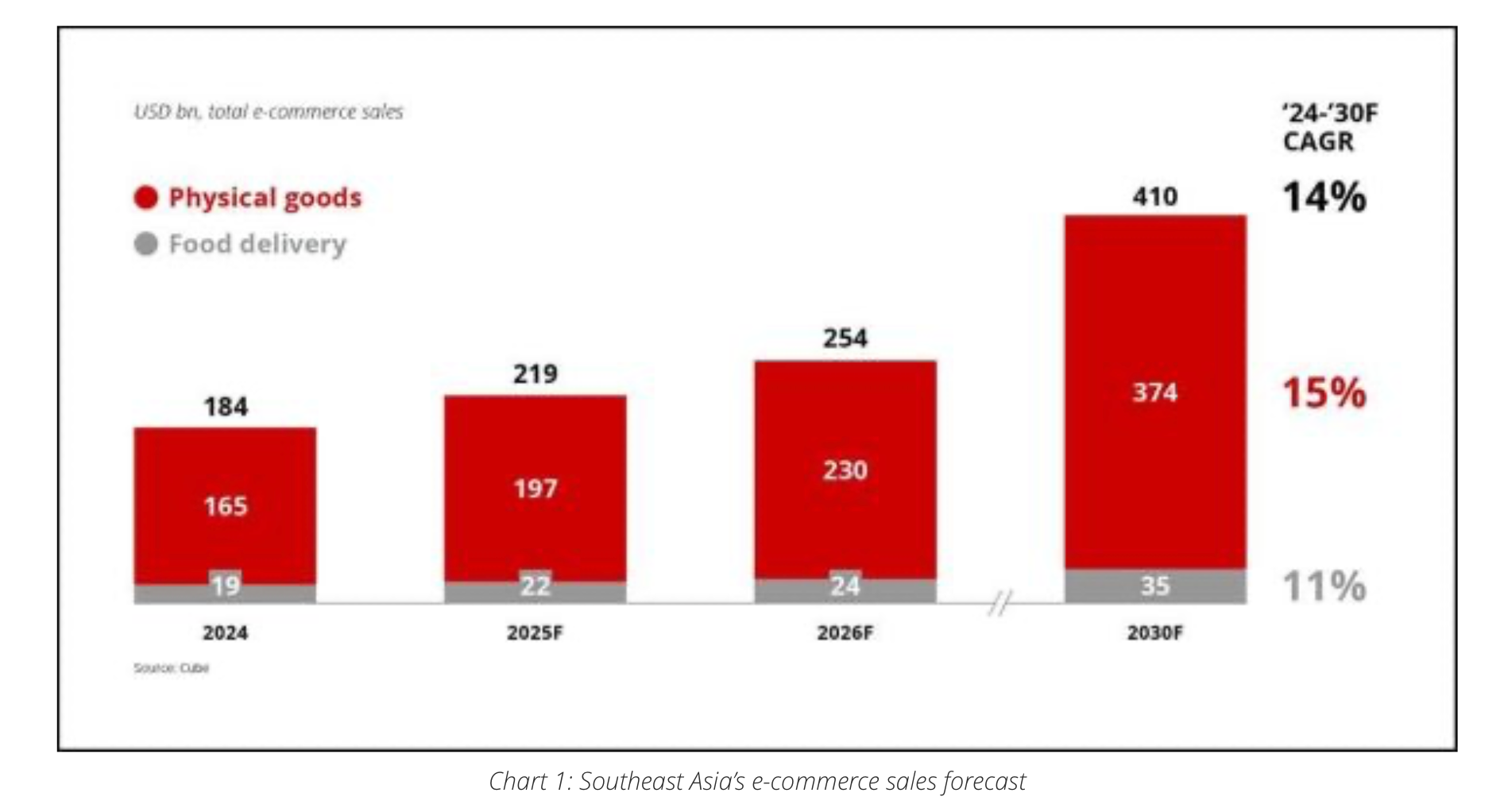
After growing by around 21% annually between 2020 and 2024, the industry is now shifting its focus from aggressive customer acquisition toward profitability, operational efficiency and long-term customer retention. Several of Southeast Asia’s largest e-commerce players have already achieved profitability through market consolidation, higher platform fees and greater focus on their core businesses.
At the same time, platforms are investing beyond the marketplace itself. Warehousing, last-mile delivery, integrated payments and other e-commerce infrastructure are becoming increasingly important, creating more sophisticated ecosystems for both consumers and sellers.
Technology will play a central role in the sector’s next stage. AI is expected to move beyond operational applications such as product tagging toward personalized recommendations, immersive shopping experiences and more tailored customer journeys. Frictionless payments, smarter logistics and embedded finance are also expected to become important competitive differentiators.
Overall, the report points to a Southeast Asian e-commerce market that is not only becoming significantly larger, but also more mature, integrated and technologically advanced. For international brands, this development creates an increasingly established infrastructure through which products can reach Southeast Asia’s growing digital consumer base.
*Source: DBS – Southeast Asia e-commerce enters next phase of growth.
Southeast Asia’s e-commerce market continues to expand rapidly, creating new opportunities for international brands.
According to research conducted by Cube Asia for Lazada, authenticity-driven e-commerce represented approximately USD 40 billion in sales in 2025 and is projected to reach USD 150 billion by 2030. The study also found that 80% of surveyed consumers were willing to try new or overseas brands when their preferred products were unavailable, indicating potential demand for international products.
Cross-border commerce represents another significant growth opportunity. Research by Citi and Cube estimates that Southeast Asia’s cross-border e-commerce market could expand from USD 17 billion in 2024 to USD 42 billion by 2030 under its base-case scenario.
For European brands, these developments highlight an opportunity to reach new consumers through established marketplaces. However, success depends on identifying products that match local demand, navigating country-specific regulations and building efficient distribution operations.
*Sources:
Cube Asia – The Rise of Authenticity-Driven SEA E-commerce;
Citi – The Rise of Cross-Border E-commerce in Southeast Asia
Southeast Asia's e-commerce landscape is increasingly dominated by three major platforms: Shopee, Lazada and TikTok Shop.
According to Momentum Works' Ecommerce in Southeast Asia 2026 report, these platforms, including Tokopedia under TikTok's control, accounted for 98.8% of the region's platform e-commerce GMV in 2025, representing a combined market worth approximately USD 155.8 billion.
Shopee remains the region's largest marketplace, generating USD 83.2 billion in GMV in 2025. TikTok Shop followed with USD 45.6 billion, while Lazada recorded approximately USD 18 billion. Together, these platforms provide access to established digital shopping ecosystems across Indonesia, Malaysia, Thailand, Vietnam, the Philippines and Singapore.
For European brands, Lazada presents a particularly interesting opportunity because of its focus on branded products and international commerce. Its premium marketplace, LazMall, connects consumers with more than 32,000 international and local brands, offering authenticity guarantees, delivery services and customer protection. Lazada also explicitly supports cross-border sellers from Europe, alongside other international markets.
The platform's growing focus on quality and authenticity is especially relevant for European businesses competing through product differentiation rather than low prices. According to Momentum Works' 2026 research, Lazada's shift toward higher-value branded products has gained traction in Singapore, Thailand and the Philippines, contributing to higher average order values.
*Source: Momentum Works – Ecommerce in Southeast Asia 2026.
Expanding into Southeast Asia means navigating six major e-commerce markets - Indonesia, Thailand, Vietnam, the Philippines, Malaysia and Singapore - each with different consumer preferences, regulations, competitive dynamics and marketplace structures.
Product selection is one of the first challenges. A product performing well in Europe does not automatically have the same potential in Southeast Asia, or even across different Southeast Asian countries. Differences in purchasing power, beauty and fashion preferences, climate, cultural habits and price sensitivity make local market knowledge essential when deciding which products to introduce and where.
The operational side adds another layer of complexity. Cross-border sellers need to manage import requirements, customs, taxes, warehousing, fulfilment, last-mile delivery, returns and local payment methods. Citi's research on Southeast Asian cross-border e-commerce identifies logistics costs, regulatory complexity and fragmented payment systems among the barriers that continue to affect cross-border expansion.
Selling through marketplaces also comes with platform-specific requirements. On Lazada, for example, brands and distributors seeking to sell through LazMall must meet eligibility and authenticity requirements. Depending on seller status, this can include proof of trademark ownership or authorization to distribute the brand, documentation demonstrating legitimate product sourcing, and compliance with the platform's seller and product policies.
For European brands, this means that the opportunity is substantial, but entering the region independently can require significant local expertise, infrastructure and operational resources. A distribution model that combines local product selection with wholesale purchasing, logistics and marketplace management can substantially reduce these barriers to entry.
*Source: Lazada Seller Center – LazMall Joining.
Together with our Singapore-based company, Armonia Pte Ltd, we help European brands connect their systems to local marketplaces and support the ongoing work needed to sell online, from catalogue management to marketplace operations and digital marketing.
Our approach combines technical expertise with experience in the region. We are developing more integrated solutions to reduce setup work and simplify daily operations, making expansion more accessible to brands with limited internal resources.
The goal is simple: help brands build sales in Southeast Asia with less complexity, less work for their teams, and less risk.
Any questions? Fill in the form and we will be back to you soon
